
News
2023On October 25, the 30th Annual Conference and Exhibition of the China Society of Automotive Engineers (SAECCE 2023), themed "Science and Technology Leading the High-Quality Development of the Automotive Industry", grandly opened at the Beijing Beiren Yichuang International Exhibition Center.
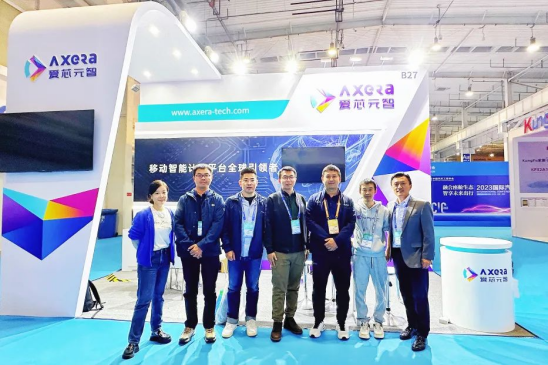
With its strong independent chip R&D capabilities and implementation achievements in the intelligent driving track, Axera was invited to deliver a keynote speech entitled "Building High-Performance Autonomous Driving Chips - Begin with the End in Mind + Seamless System Integration", sharing Axera's insights on exploring the optimal solutions for automotive chips in response to the industry's pain points. Meanwhile, a series of automotive chips, development kits/ Demos, and mass-produced partner samples were exhibited on site, which received unanimous praise from the attendees.
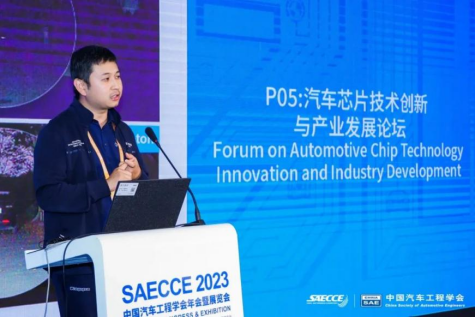
Li Chen, Senior Director of Intelligent Algorithms, Automotive Business Unit, Axera
Over the past 20 years, China's automotive industry has explored a path of transformative development driven by technological innovation through practice. Industrial technological innovation has continued to deepen, breakthroughs in key core technologies have been made consistently, and major innovative achievements have emerged one after another, supporting the continuous expansion of the industrial scale and the steady improvement of development quality and efficiency.
With the accelerated electrification, connectivity and intelligence of automobiles, the importance of automotive chips to vehicle reliability, safety and performance is self-evident. The automotive industry is in urgent need to carry out application and innovation research on automotive chips to meet the new demands under the current industrial transformation.
Axera believes that the six major pain points in the autonomous driving industry are poor visibility, inaccurate perception recognition, imprecise measurement, incomplete detection, severe accuracy degradation in deployment, and low deployment efficiency. Relying on two self-developed core technologies — Axera Smart Vision AI-ISP and Axera Smart Compute mixed-precision NPU, as well as rich experience in large-scale mass production, Axera can help industry partners implement high-performance, low-power, safe and reliable intelligent driving solutions. The comprehensive product line addresses the six major industry pain points in a targeted manner and meets the diverse needs of customers.
Problem 1: Poor Visibility
Scenarios such as high dynamic range when entering and exiting tunnels, low-light conditions with dark vehicles at night, severe weather like rain, fog and snow, and motion blur during high-speed driving all demand high dynamic range, and perception performance is limited in low-light environments. Based on its self-developed core technology — Axera Smart Vision AI-ISP, Axera has proposed automotive HDR system solutions and automotive low-light system solutions. These solutions enhance the effects of HDR and noise reduction processing, significantly improving the image performance and experience in the above scenarios.
Problem 2: Inaccurate Perception Recognition
Inaccurate perception recognition refers to the failure of machine vision to detect targets during perception. By integrating backend CV/semantic applications, Axera has built a closed-loop evaluation system for image quality perception, solving the problem of poor actual performance despite seemingly acceptable image quality, and enabling closed-loop intelligent image quality control and intelligent scene control for automotive intelligent imaging.
Simply put, based on Axera Smart Vision AI-ISP technology, Axera, on the one hand, conducts refined modeling of sensor characteristics and optimizes image processing strategies to the extreme, such as upgrading 2D noise reduction to 3D noise reduction; on the other hand, it fully leverages the data-driven characteristics of AI algorithms to achieve enhanced performance in higher dimensions, comprehensively improving the performance of intelligent driving in complex and challenging scenarios, helping to achieve excellent perception performance and ensuring driving safety.
Problem 3: Imprecise Measurement
Imprecise measurement means that the perception module itself cannot accurately measure spatial information, such as the detection of general obstacles, object tracking, odometry, dynamic calibration, map construction, ranging and speed measurement. Axera effectively improves the accuracy and reliability of perception solutions through hardware-accelerated depth and optical flow processing. Depth/optical flow algorithms are the most computationally complex part of CV algorithms. The CV Depth Engine delivers 1080p30 performance, supports binocular disparity search within a 224-point range and symmetric omnidirectional aggregation; the CV Optical Flow Engine enables multi-scale range expansion, supports ROI-based tracking point density control and iterative accuracy optimization.
In terms of multi-source fusion positioning, map topology construction, and CV geometric perception, Axera integrates powerful computing power and ultra-low power consumption. With two self-developed core technologies — Axera Smart Vision AI-ISP and Axera Smart Compute mixed-precision NPU, Axera supports the construction of flexible frameworks for different Slam algorithms from the SoC level to the SDK level. For different parking and driving applications, visual or Lidar input solutions, and different functions such as local positioning/map-based positioning/online mapping, Slam can be combined into a variety of variant solutions. Axera provides an optimized function library for a series of compute-intensive operators to facilitate the efficient and rapid deployment of Slam applications.
Problem 4: Incomplete Detection
To address the limitation of incomplete detection of general obstacles, Axera has designed a hardware accelerator that enables seamless multi-channel parallel processing, online image format conversion, cropping and scaling. Based on geometric and physical modeling-based CV algorithms, which play a role similar to a ruler's measurement, it effectively complements AI-based semantic perception in various aspects such as general obstacle perception, ranging and speed measurement, and object tracking. It efficiently supports multi-scale and multi-ROI perception, greatly optimizing processing latency and bandwidth resource consumption, and effectively avoiding aliasing effects during high-rate downsampling.
Axera's preprocessing system supports Task-Aware Filter, which flexibly configures downsampling filter coefficients according to different tasks such as optical flow, feature matching, and NPU perception, enabling each backend task to achieve its optimal performance. Flexible data flow configuration and offline/online mode switching can be realized between different hardware according to business needs, balancing flexibility while optimizing system performance such as latency and bandwidth.
Problem 5: Severe Accuracy Degradation in Deployment
Perception model deployment often faces problems such as insufficient on-board performance and severe accuracy degradation. Relying on the unique design of the self-developed Axera Smart Compute mixed-precision NPU, Axera has verified through experiments that Transformer models can achieve rapid PTQ deployment through mixed-precision optimization while effectively maintaining model accuracy. On the other hand, by optimizing the design of vector cores and data IO for Transformer characteristics, Axera has realized the efficient deployment of various Transformer models, delivering excellent performance for Transformer models. From the perspective of the SoC system, Axera optimizes system-level heterogeneous scheduling of NPU, CPU, DSP, GPU and various ASIC units.
Problem 6: Low Deployment Efficiency
To solve practical engineering problems such as cumbersome and time-consuming deployment processes, Axera is equipped with mature toolchains, deployment guideline manuals and off-the-shelf reference designs. The NPU is the core of perception. Axera Smart Compute mixed-precision NPU adopts a high-efficiency heterogeneous multi-core architecture with tensor, vector and IO engines. Cooperating with a wealth of dedicated operator accelerators, it can achieve efficient inference of various automotive AI models through flexible scheduling. The mixed-precision design supports low-bit model acceleration or high-bit/floating-point accuracy enhancement. The collaborative design of application algorithms enables the supported model library to be continuously updated with industrial iteration, ensuring high utilization rate and low power consumption of the NPU for the running tasks.
After years of mass production iteration, Axera's toolchain has accumulated many excellent features, such as efficient PTQ deployment, in-depth QAT quantization, and support for accurate model simulation. Its user-friendly features have earned high praise from customers who commented that they can get started with the platform in just one hour from scratch.
For models commonly used in automotive scenarios (such as BEV), based on in-depth understanding and optimization of its own platform, Axera provides APIs covering backbone networks, spatiotemporal fusion, and various detection heads, modularizing and commercializing the optimal designs adapted to the Axera platform for customers to integrate flexibly. Meanwhile, Axera also provides automotive model design guideline manuals and more comprehensive reference designs for perception models to further help customers achieve efficient deployment and implementation.
In the automotive field, Axera clearly positions itself as a Tier 2 supplier and adheres to the concept of "Begin with the End in Mind, Seamless System Integration". Starting from practical business needs and combining scenario characteristic analysis, Axera guides rational trade-offs in SoC design; from the overall SoC system level, Axera coordinates the interaction between various functional sub-modules, making the SoC chip a truly organic on-chip integrated system. Axera works hand in hand with partners to help customers achieve rapid mass production and implementation, give full play to the value of its own platform, and realize ecological win-win.
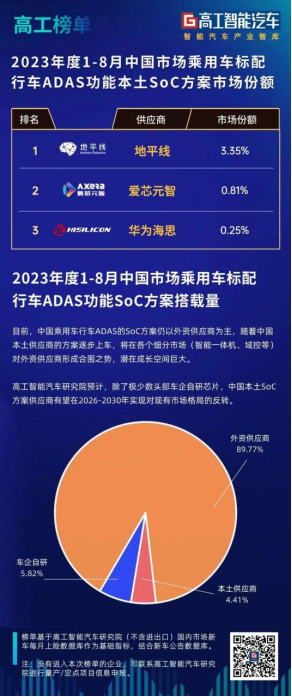
According to the list of "Market Share of Domestic SoC Solutions for ADAS Functions Standard Equipped in Passenger Cars in China's Market from January to August 2023" released by Gaogong Intelligent Automotive Research Institute, Axera ranked second.